Feature
Know what every customer owes you, to the centime
Record partial payments, correct an issued invoice with a numbered credit note and spot overdue invoices: agreed due date, or 60 days by default under law 69-21.
Demo on request · Pricing on request · Guided setup
Unpaid invoices get lost in notebooks
Deposits written in a notebook, transfers checked on the bank statement, reminders from memory.
- Partial payments that cannot be matched to the right invoice
- Invoices already sent and edited afterwards, with no trace
- No reliable list of overdue invoices and how old they are
From invoice to collection
- 1
Issue the invoice: it gets its number and can no longer be edited
- 2
Record each payment, full or partial, with its date and method
- 3
Track the balance due and the status of each invoice
- 4
Correct a mistake or a cancellation with a numbered credit note
- 5
Spot overdue invoices in the ageing report
Partial payments and invoice status
A customer pays in instalments? Record each payment against the invoice: date, amount and method (cash, cheque, bank transfer, bill of exchange…). Nizam computes the balance due with exact decimal arithmetic, without approximate rounding.
The status follows the payments: draft, issued, paid or overdue. The balance due takes credit notes issued on the invoice into account, and you see what is still to be collected per customer.
An issued invoice is never edited: you correct it with a credit note
Once issued, an invoice is locked. To correct a price, grant a forgotten discount or cancel all or part of a sale, you issue a credit note linked to the original invoice. Credit notes have their own numbering (AV-), continuous, chronological and gap-free, and their own PDF with your logo.
A credit note can never exceed what was invoiced, line by line and in total. Credited quantities become invoiceable again on the order, so you can re-invoice correctly.
A credit note alone corrects the amount due; it does not put goods back into stock. If items come back to you, record a customer return from the delivery note or the invoice: resaleable goods go back into the chosen warehouse, damaged goods are only recorded, and the credit note for the returned lines can be created in the same step.
Receivables and late payments (law 69-21)
An invoice is overdue when it has been issued, is not fully paid and its due date has passed. When no due date was agreed, Nizam counts 60 days from the invoice date, the default term set by law 69-21.
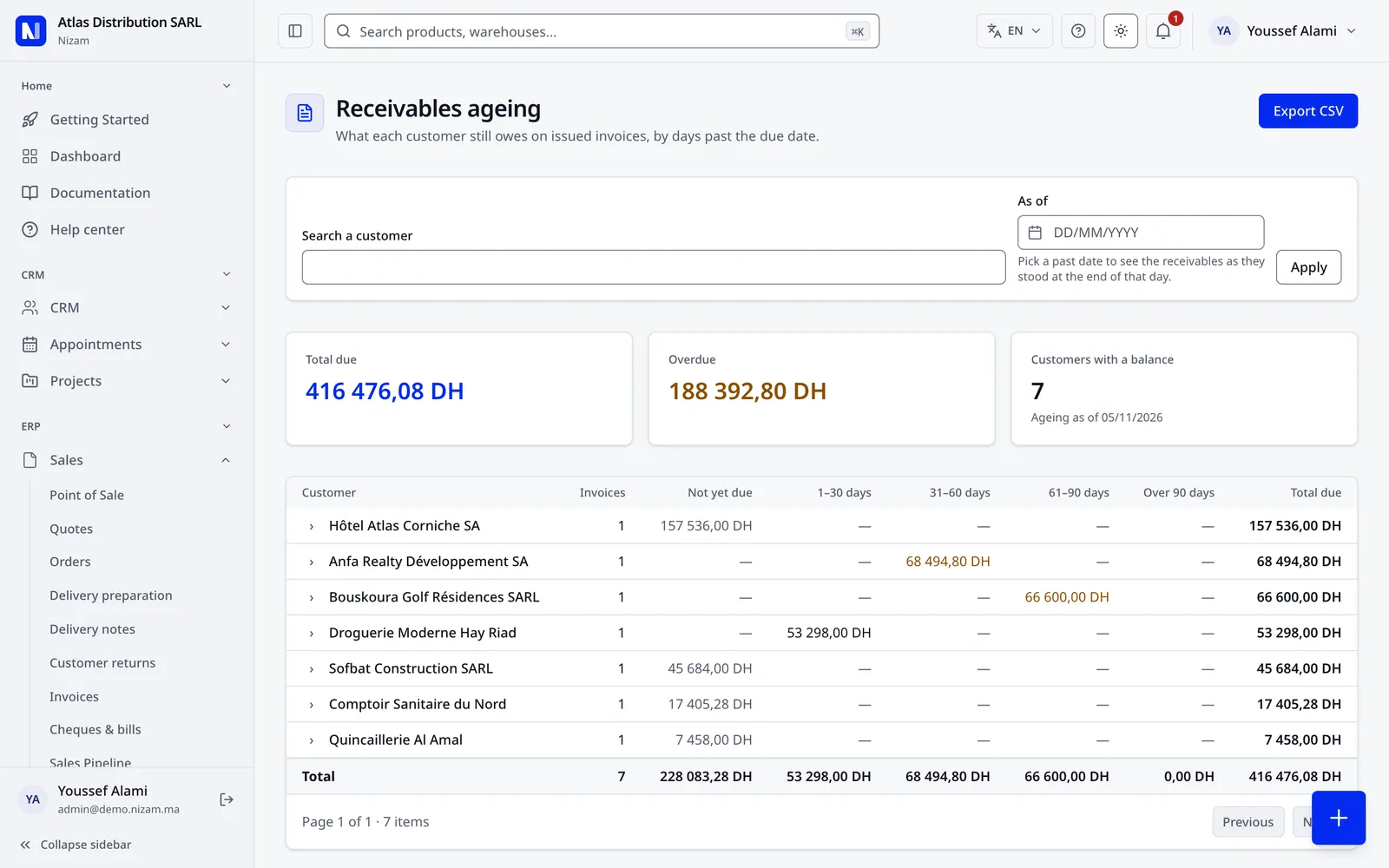
The ageing report groups amounts due by customer and by age (not yet due, 1 to 30 days, 31 to 60, 61 to 90, over 90 days) and exports to CSV for your accountant. Payment-term reporting is then filed on the DGI portal.
Amount in words, in French
Every invoice shows its total in words, in French: “Arrêtée la présente facture à la somme de … dirhams et … centimes”. No more writing it out by hand.
Online invoice payment
On activation, your customers pay online by card. Nizam processes online payments through a reliable and secure third-party payment provider; Nizam stores no card data.
Two modes to choose from: the money reaches your own merchant account, or « Collection by Nizam »: Nizam receives your customers’ payments and pays them out to your bank account, by cheque or bank transfer, with a statement for each payout.
- « Pay online » link on the invoice page, in the e-mail, in the WhatsApp message and on the PDF with a QR code
- Online deposit on a quote, and online payment of your shop’s orders, next to cash on delivery
- Payment recorded once on the invoice; a partial payment leaves the balance due
- Provider fees recorded separately as bank charges (account to be validated by your accountant)
- Refunds, and a reconciliation list of online payments against those recorded in Nizam
Moroccan specifics, already in place
Payments and credit notes rely on invoicing built for Morocco:
- 2026 VAT preconfigured (20%, 10% and exempt), broken down by rate on every document
- Seller ICE, IF, RC and taxe professionnelle, and the business customer’s ICE, printed on the PDFs
- Amounts in dirhams (DH), exact to the centime
- Default 60-day term (law 69-21) when none was agreed
What Nizam does not do
Cash, cheque, transfer and bill-of-exchange payments are recorded by your team; only online payments record themselves. Nizam executes no transfer automatically: with collection by Nizam, each payout is prepared, approved, then sent with its reference. Supplier payments are tracked on the Supplier invoices page. Stamp duty on cash payments is calculated if you switch it on in the company settings, at the rate you enter (to be confirmed with your accountant): it is then recorded on each cash payment.
Useful links
- Invoicing
- Dashboards and reports
- CGNC accounting
- Supplier invoices and payments
- Bank statements and reconciliation
- Payment terms: law 69-21
- Invoice numbering in Morocco
- Stamp duty in Morocco
- Credit notes: when and how to issue them (in French)
- Partial payments and customer balances (in French)
- Late-payment fine calculator (law 69-21)
Pricing
On request: our pricing depends on your modules, number of users and the support you need.
Frequently asked questions
Does Nizam help track payment terms?
Nizam records payments, full or partial, on each invoice and shows what remains to be collected per customer. It also prepares the payment-terms statement (law 69-21), to be validated by your accountant; you then file it on the DGI portal. The calculation rules have not yet been signed off by an accountant.
What is Law 69-21 on payment terms?
Law 69-21 sets the payment term between companies at 60 days by default, and 120 days maximum by agreement. Since 2025 it applies to companies with turnover above 2 million dirhams, which declare their payment delays to the DGI. A company that pays late owes a fine to the Treasury (not to the supplier). (as of 13/10/2026)
Can my customers pay an invoice online?
Yes, on activation. The invoice carries a « Pay online » link (page, e-mail, WhatsApp message, PDF with a QR code); the customer pays by card and the payment is recorded once on the invoice. Nizam processes online payments through a reliable and secure third-party payment provider and stores no card data.
How do I correct an invoice that has already been issued?
With a credit note. In Nizam, an issued invoice cannot be edited: you create a credit note linked to that invoice, numbered in the AV- series, for all or some of its lines. The credit note cannot exceed the invoiced amount and reduces the customer’s balance due.
Does a credit note put goods back into stock?
Not the credit note alone: it corrects the invoiced amount. The customer return, recorded from the delivery note or the invoice, puts resaleable goods back into the chosen warehouse; it can create the credit note for the returned lines in the same step, and the movement stays traceable in the history.
When is an invoice considered overdue?
An invoice is overdue when it has been issued, is not fully paid and its due date has passed. With no agreed due date, Nizam uses 60 days after the invoice date, the default term under law 69-21.
Does the amount in words appear on Nizam invoices?
Yes, in French. Every invoice shows “Arrêtée la présente facture à la somme de … dirhams et … centimes”, computed from the total including VAT. The amount in words is not available in Arabic or English.
Track collections without a notebook
Book a demo on your own invoices.